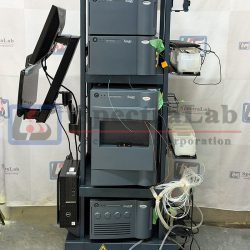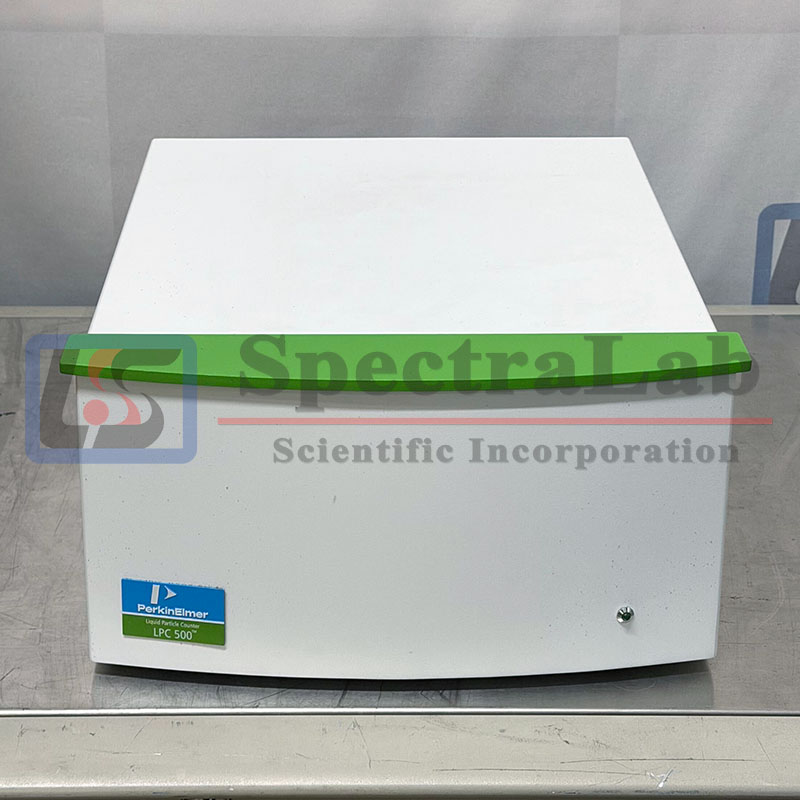
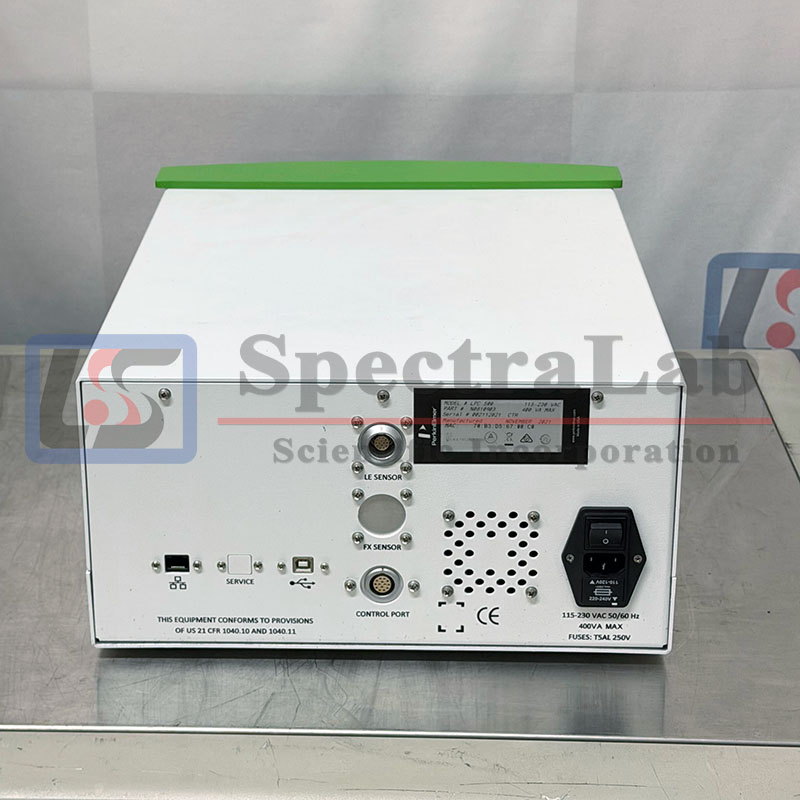
The PerkinElmer LPC 500 Liquid Particle Counter is a high-resolution analytical system designed for automated particle counting and sizing in liquid samples, particularly lubricating oils and other industrial fluids. Utilizing Single Particle Optical Sizing (SPOS) technology, the LPC 500 detects and measures individual particles as they pass through a precisely defined optical sensing zone. This approach provides reliable particle count and size distribution measurements, making it a valuable tool for lubricant condition monitoring, contamination assessment, and equipment wear analysis.
Key Components and Technology
The LPC 500 consists of three main components: an optical sensor, a Multi-Channel Pulse Analyzer (MPA), and a software controller. The optical sensor uses both light extinction and light scattering techniques to detect individual particles and generate corresponding optical signals. The MPA measures the height of each signal and determines particle diameter through interpolation using the sensor calibration curve. The software controller manages particle counting operations, data processing, and reporting.
Configurations and Software
The LPC 500 is available in both standalone and integrated configurations. In standalone operation, it functions as an independent liquid particle counting system with dedicated software that allows customization of particle counting parameters. Alternatively, it can be integrated with the PerkinElmer Avio 500/550 Max ICP-OES Oils system, enabling particle counting, particle sizing, and elemental analysis of wear metals from the same prepared sample. In the integrated configuration, particle counting functionality and data outputs are incorporated into PerkinElmer Syngistix for ICP software, providing a unified platform for instrument control, data acquisition, and analysis.
Specifications and Performance
The LPC 500 is designed to handle both high- and low-viscosity oil samples while minimizing sample consumption, washout requirements, and solvent waste. Typical sample preparation for in-service oil analysis requires approximately 4 mL of a 10-times-diluted sample, corresponding to less than 1 mL of original lubricant. The integrated Avio ICP-OES configuration can achieve average sample-to-sample analysis times of approximately 45 seconds, while the standalone configuration offers approximately 95 seconds per sample. Its high-speed optical sensing technology supports particle counting rates exceeding 10,000 particles per second.
Applications
The PerkinElmer LPC 500 is particularly suitable for in-service lubricant analysis, hydraulic oil testing, machinery condition monitoring, industrial maintenance programs, and contamination assessment. When combined with ICP-OES, it provides complementary information on particle size and concentration alongside elemental wear-metal analysis, helping laboratories evaluate equipment condition and identify potential wear-related issues.
Physical Specifications
The LPC 500 has a compact footprint, with dimensions of approximately 37 cm (W) × 47 cm (D) × 19 cm (H) and a weight of approximately 8.5 kg, making it suitable for laboratory bench installation.